Getting Botox for the first time can feel overwhelming. You probably have questions about pain, cost, results, and whether you will still look like yourself afterward.
The good news? Botox is one of the most studied cosmetic treatments in the world, with over 20 years of clinical data and millions of treatments performed every year. At Maroc Hamam Spa in Frisco, TX, our physician-led team walks every first-time patient through the entire process so you feel confident before, during, and after treatment.
This guide covers everything you need to know before your first Botox appointment, from preparation and the injection process to results timelines, aftercare, costs, and safety.
What Is Botox and How Does It Work?
The Science Behind Botox
Botox is a brand name for onabotulinumtoxinA, a purified protein derived from botulinum toxin type A. It is manufactured by Allergan and has been FDA-approved for cosmetic use since 2002.
Botox temporarily blocks the release of acetylcholine, a chemical messenger that signals muscles to contract. When injected into specific facial muscles, Botox relaxes them just enough to smooth out wrinkles caused by repetitive movements like squinting, frowning, and raising your eyebrows.
The result is smoother skin and softer expression lines without affecting your ability to show emotion. A skilled injector targets only the muscles responsible for specific wrinkles, leaving surrounding muscles untouched.
According to the American Society of Plastic Surgeons, over 8.7 million botulinum toxin treatments were performed in the United States in 2023 alone, making it the most popular minimally invasive cosmetic procedure in the country.
What Does Botox Treat?
Botox is most effective on dynamic wrinkles. These lines form when you move your face and disappear when your face is at rest. Over time, dynamic wrinkles can become static wrinkles that remain visible even when you are not making an expression.
The most common treatment areas include:
- Forehead lines (horizontal lines caused by raising your eyebrows, targeting the frontalis muscle)
- Frown lines (the “11s” between your eyebrows, targeting the corrugator supercilii and procerus muscles)
- Crow’s feet (lines radiating from the outer corners of your eyes, targeting the orbicularis oculi muscle)
Other treatment areas include bunny lines on the nose, lip lines, chin dimpling, and platysmal bands on the neck. Botox can also slim the jawline by relaxing the masseter muscle.
Beyond cosmetic use, Botox treats chronic migraines, excessive sweating (hyperhidrosis), and TMJ disorders, though these medical applications require different dosing and injection patterns.
How to Prepare for Your First Botox Appointment?
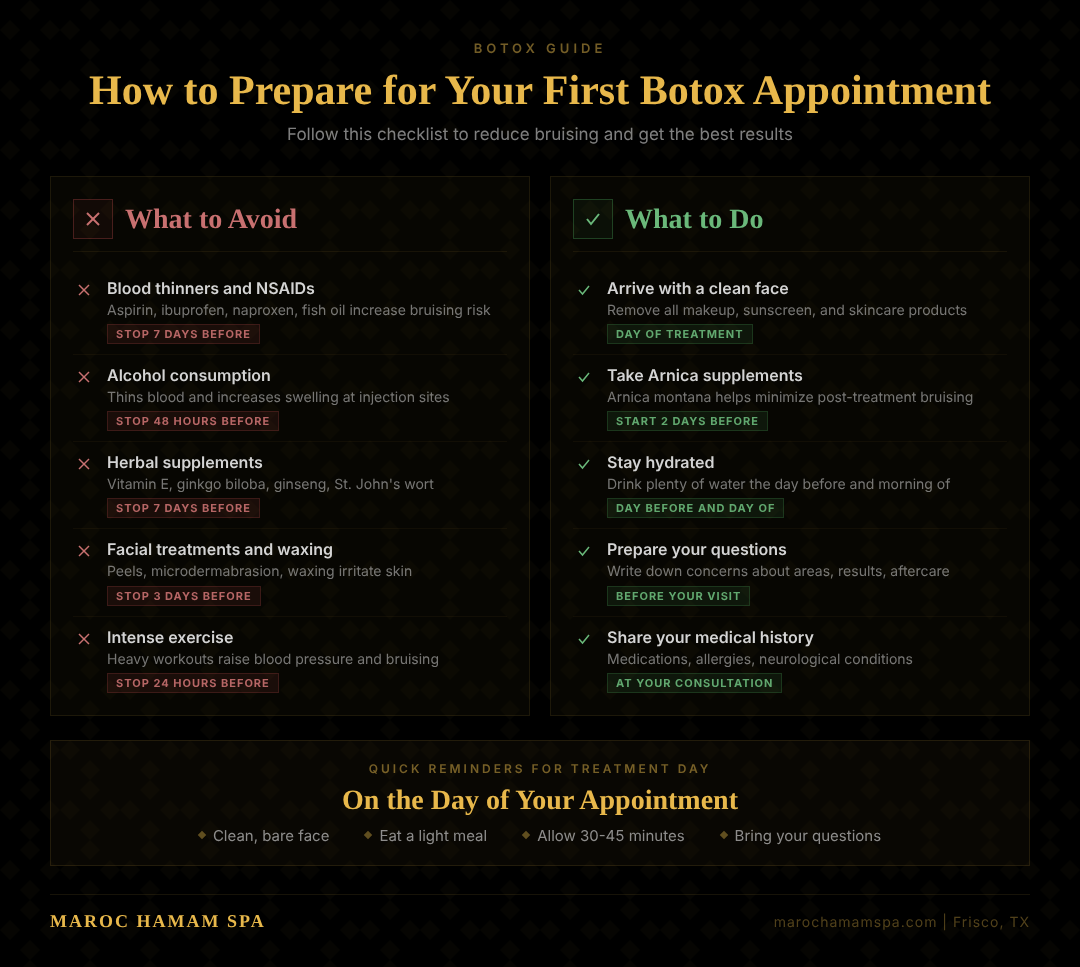
Proper preparation helps you get the best results and reduces the chance of bruising or other side effects.
What to Avoid Before Botox
Start adjusting your routine 7 to 10 days before your appointment:
- Blood-thinning medications: Stop taking aspirin, ibuprofen (Advil, Motrin), and naproxen (Aleve) unless your doctor prescribes them. These increase bruising risk. Always check with your prescribing physician before stopping any medication.
- Supplements: Pause fish oil, vitamin E, ginkgo biloba, garlic supplements, and St. John’s wort. These also thin the blood.
- Alcohol: Avoid drinking alcohol for at least 24 to 48 hours before treatment. Alcohol dilates blood vessels and increases bruising.
- Intense exercise: Skip heavy workouts the morning of your appointment. Elevated blood pressure increases blood flow to the face.
- Facial treatments: Avoid waxing, chemical peels, facials, and microdermabrasion on the treatment area for at least 24 hours before your appointment.
What to Do Before Your Appointment
- Schedule a consultation. At Maroc Hamam Spa, we offer complimentary consultations so you can discuss your goals, ask questions, and understand exactly what to expect before committing to treatment.
- Share your full medical history. Tell your provider about all medications, supplements, allergies, and any history of neuromuscular conditions.
- Come with a clean face. Remove all makeup from the treatment area before arriving, or plan to arrive early so the team can cleanse your skin.
- Consider arnica supplements. Starting arnica montana 2 to 3 days before treatment can help minimize bruising, though it is optional.
- Eat a light meal. Arriving on an empty stomach can increase lightheadedness, especially if you are nervous.
Questions to Ask Your Provider
Your consultation is the time to evaluate whether you are in the right hands. Ask your provider:
- How many years of experience do you have with Botox injections?
- How many units do you recommend for my specific concerns?
- What brand of neurotoxin do you use, and why?
- Is a physician involved in overseeing treatments?
- Can I see before-and-after photos of previous patients?
At Maroc Hamam Spa, Dr. Amir Baluch, MD, supervises all injectable treatments, ensuring physician-level oversight for every patient.
What to Expect During Your First Botox Treatment
If you are getting Botox for the first time, knowing exactly what happens during the appointment can ease a lot of anxiety. The entire process is faster and more comfortable than most people expect.
The Consultation
Your appointment begins with a facial analysis. Your provider will examine your facial muscles at rest and in motion to identify the areas that would benefit most from treatment.
You will discuss your goals, whether that is softening forehead lines, reducing crow’s feet, or preventing wrinkles from deepening. Your provider will create a customized treatment plan, recommend specific unit counts for each area, and take before photos to track your results.
This is also when your provider reviews contraindications and confirms that Botox is safe for you.
The Injection Process Step by Step
Once your treatment plan is set, the actual injection process looks like this:
- Your provider cleanses the treatment area with an antiseptic solution.
- Some providers apply a topical numbing cream or ice, though most patients do not need it.
- Your provider marks the injection sites on your face using a removable marker.
- Using a fine-gauge needle (typically 30-gauge, much thinner than a standard blood draw needle), your provider injects small amounts of Botox into each targeted muscle.
- The number of injection points varies by area. Forehead treatment may involve 4 to 8 injection points, while crow’s feet typically require 3 to 4 points per side.
- The entire process takes 10 to 20 minutes, sometimes even less.
That is it. No incisions, no anesthesia, and no recovery room. You leave the appointment and go about your day.
Does Botox Hurt?
This is the number one question from first-time Botox patients, and the honest answer is: barely.
Most patients rate the discomfort at a 2 or 3 out of 10. The sensation is like a quick pinch or mosquito bite, and it lasts only a few seconds at each injection site.
The forehead and crow’s feet areas are usually the least sensitive. The frown line area between the eyebrows can feel slightly more intense because the skin is thicker there, but the discomfort is still very mild.
If you are particularly sensitive, your provider can apply a topical anesthetic or use ice before injecting. At Maroc Hamam Spa, our women-only environment is designed to keep you relaxed and comfortable throughout the experience.
How Many Units of Botox Do You Need for the First Time?
The number of Botox units you need depends on your treatment areas, muscle strength, and desired results. Your provider will recommend a specific plan during your consultation.
Botox Units by Treatment Area
Here are the typical unit ranges for first-time patients:
| Treatment Area | Typical Units |
| Forehead lines | 10-30 units |
| Frown lines (glabellar) | 15-25 units |
| Crow’s feet (both sides) | 12-24 units |
| Bunny lines | 5-10 units |
| Lip lines | 4-8 units |
| Chin dimpling | 2-6 units |
For first-time patients, most providers recommend starting with a conservative dose. You can always add more at a follow-up appointment, but you cannot take Botox away once it is injected.
What Does Botox Cost in Frisco, TX?
Botox pricing in the Frisco and Dallas-Fort Worth area typically ranges from $10 to $15 per unit. Your total cost depends on how many areas you treat and how many units each area requires.
A typical first-time Botox treatment covering forehead lines, frown lines, and crow’s feet uses about 40 to 64 units, putting the total cost between $400 and $960 for a full upper-face treatment.
Some clinics charge by area rather than by unit. Unit-based pricing gives you more transparency because you know exactly what you are paying for.
Botox is a cosmetic procedure and is not covered by health insurance. At Maroc Hamam Spa, we offer complimentary consultations so you can understand the full cost before committing.
Botox Results Timeline: When Will You See Results?
One of the biggest surprises for first-time Botox patients is that results are not instant. The neurotoxin needs time to bind to the nerve endings and take effect.
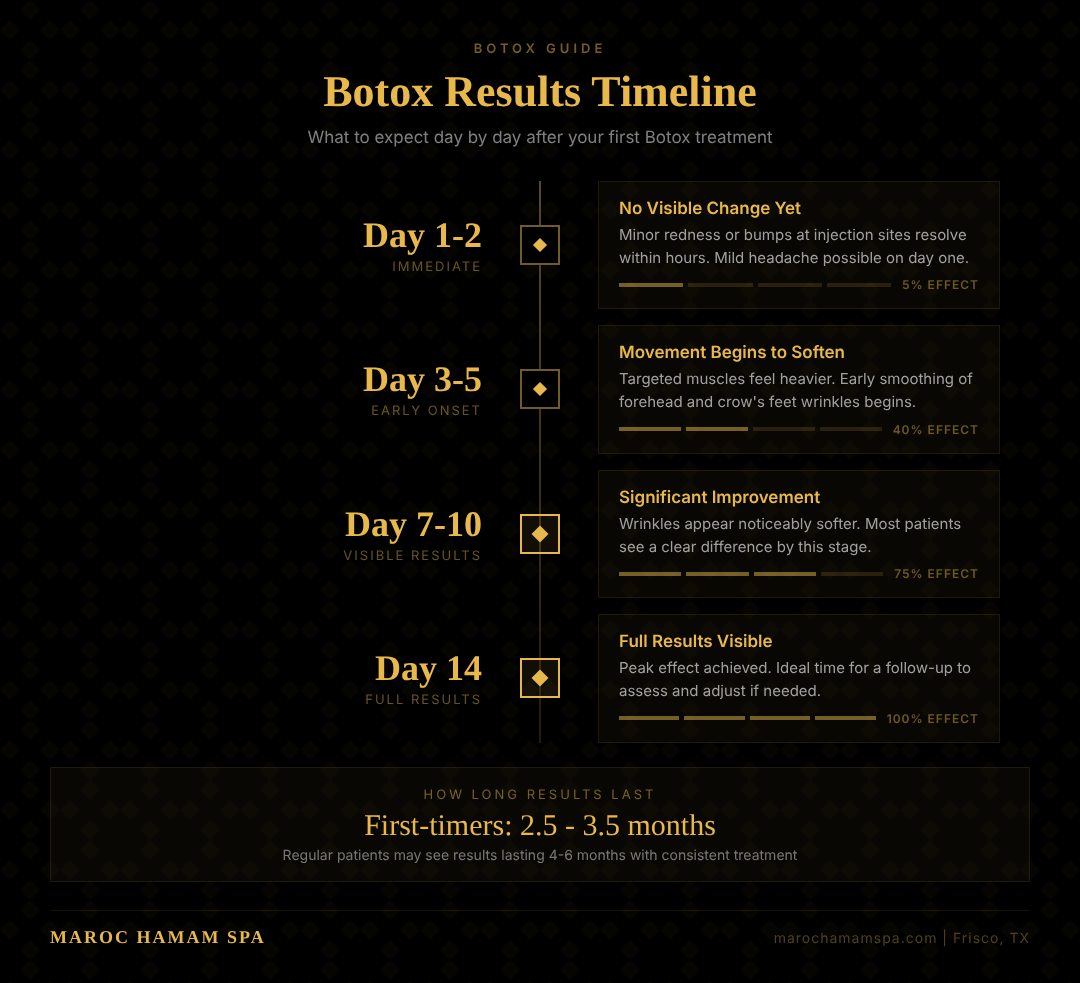
Day-by-Day Results After Your First Treatment
Days 1 to 2: You will not see any visible difference yet. Minor redness, slight swelling, or small bumps at injection sites are normal and typically resolve within a few hours. Some patients experience a mild headache on the first day.
Days 3 to 5: You will start to notice your targeted muscles feel “heavier” or less responsive. Early smoothing of dynamic wrinkles begins, particularly in the forehead and crow’s feet areas.
Days 7 to 10: Significant improvement becomes visible. Wrinkles appear noticeably softer, and you may find it harder to create the deep expressions that caused those lines.
Day 14: Full results are visible. This is the ideal time for a follow-up appointment to assess whether you need a touch-up. If any areas appear slightly uneven, a small adjustment can perfect the results.
How Long Does Botox Last?
For first-time patients, Botox typically lasts 2.5 to 3.5 months. With regular treatments, results often last 4 to 6 months because consistent treatment weakens the targeted muscles over time. This is sometimes called the “muscle memory” effect.
Several factors influence how long your results last:
- Metabolism: A higher metabolism can break down the neurotoxin faster.
- Muscle strength: Stronger facial muscles may metabolize Botox more quickly.
- Dosage: Higher unit counts tend to produce longer-lasting results.
- Activity level: Intense exercise and heat exposure can accelerate metabolism.
- Treatment consistency: Regular appointments maintain results and may extend their duration.
Most providers recommend scheduling your next appointment when you notice movement returning, rather than waiting until the Botox has fully worn off. This approach maintains consistent results and may reduce the total units needed over time.
Botox Aftercare: What to Do After Your First Treatment
Following aftercare instructions carefully helps you get the best results and reduces the risk of complications.
Immediate Aftercare (First 4 Hours)
- Stay upright. Do not lie down for at least 4 hours after treatment.
- Do not rub, press, or massage the injection sites. This can cause the Botox to migrate to unintended muscles.
- Avoid touching your face unnecessarily.
- Gently “exercise” the treated muscles by raising your eyebrows, squinting, and frowning. This may help the Botox absorb into the targeted muscles, though evidence on this practice is mixed.
First 24 to 48 Hours
- Avoid strenuous exercise for at least 24 hours. Light walking is fine.
- Skip alcohol for 24 hours after treatment.
- Avoid hot tubs, saunas, steam rooms, and hot showers. Excessive heat increases blood flow and can affect results.
- Do not schedule facial treatments, chemical peels, or microdermabrasion for at least 2 weeks.
- If possible, sleep on your back the first night.
- Minor bruising, swelling, or tenderness at injection sites is normal and typically resolves within a few days.
When to Contact Your Provider
While serious complications from Botox are extremely rare, contact your provider if you experience:
- A severe headache that does not improve with over-the-counter pain medication.
- Difficulty swallowing or breathing (exceedingly rare; seek emergency care).
- Noticeable eyelid drooping (ptosis), which is temporary but may benefit from treatment.
- Signs of an allergic reaction such as hives, swelling away from the injection site, or difficulty breathing.
- Significant asymmetry that has not improved by the 2-week mark.
Botox Safety and Side Effects
Botox has one of the strongest safety profiles of any cosmetic treatment. It has been extensively studied for over two decades, and cosmetic doses are far smaller than those that would pose a health risk.
Common Side Effects (Mild and Temporary)
Most side effects are minor and resolve on their own within a few days:
- Mild bruising at one or more injection sites
- Slight redness or swelling immediately after treatment
- Mild headache (usually resolves within 24 hours)
- Tenderness when touching the injection points
These effects are more common in first-time patients and tend to decrease with subsequent treatments as you learn how your body responds.
Rare Side Effects
- Ptosis (eyelid drooping): This occurs in less than 1% of cosmetic Botox treatments and is temporary, usually resolving within 2 to 4 weeks.
- Asymmetrical results: Minor unevenness can be corrected with a touch-up at the 2-week follow-up.
- “Frozen” appearance: This results from over-treatment and is why starting with a conservative dose is important, especially for first-time patients.
- Flu-like symptoms: Some patients report feeling slightly off for a day or two after treatment, though this is uncommon.
Who Should Not Get Botox (Contraindications)
Botox is not appropriate for everyone. You should not receive Botox if you:
- Are pregnant or breastfeeding
- Have a neuromuscular disorder such as myasthenia gravis or Lambert-Eaton syndrome
- Have a known allergy to botulinum toxin or any ingredient in the formulation (human albumin, sodium chloride)
- Have an active skin infection, inflammation, or open wound at the intended injection site
- Are under 18 years of age
- Are currently taking aminoglycoside antibiotics or muscle relaxants, as these can intensify the effects of botulinum toxin
Always disclose your complete medical history to your provider before treatment. At Maroc Hamam Spa, our physician-led approach means Dr. Amir Baluch, MD, reviews every patient’s medical background to ensure Botox is safe and appropriate.
Botox vs. Other Neuromodulators: What Are Your Options?
Botox is the most recognized brand name, but it is not the only FDA-approved neuromodulator available. Understanding your options helps you make an informed decision with your provider.
| Neuromodulator | Active Ingredient | Onset | Duration | Key Feature |
| Botox | OnabotulinumtoxinA | 3-5 days | 3-4 months | Most studied, longest track record |
| Dysport | AbobotulinumtoxinA | 2-3 days | 3-4 months | Faster onset, may spread more |
| Xeomin | IncobotulinumtoxinA | 3-5 days | 3-4 months | No additives, lower resistance risk |
| Jeuveau | PrabotulinumtoxinA | 3-5 days | 3-4 months | Cosmetic-only, competitive pricing |
| Daxxify | DaxibotulinumtoxinA | 3-5 days | 6-9 months | Longest-lasting option |
For first-time patients, Botox is often the default recommendation because of its extensive safety data and predictable results. However, your provider may suggest an alternative based on your treatment goals, budget, and how your muscles respond.
At Maroc Hamam Spa, Dr. Amir Baluch, MD, selects the most appropriate neuromodulator for each patient based on their individual anatomy, treatment area, and desired outcome.
Why First-Time Patients Choose Maroc Hamam Spa in Frisco, TX?
Getting Botox for the first time is a personal decision, and where you go matters as much as what you get. At Maroc Hamam Spa, we have designed every part of the experience with first-time patients in mind.
Physician-led care. Every injectable treatment is supervised by Dr. Amir Baluch, MD. This means a board-certified physician oversees your treatment plan, unit recommendations, and injection technique. Physician oversight is critical to both safety and results.
Women-only spa environment. Our spa is exclusively for women, creating a private, comfortable space where you can relax without feeling self-conscious. Many first-time patients tell us the women-only setting helped them feel at ease during their appointment.
More than a clinic. Unlike a sterile clinical environment, Maroc Hamam Spa blends modern medical aesthetics with a traditional Moroccan spa atmosphere. Your Botox appointment becomes part of a broader wellness experience, not a rushed medical procedure.
Conservative approach. We believe in a “less is more” philosophy for first-time patients. Starting with conservative units allows you to see how your face responds before adding more at a follow-up appointment. The goal is always natural-looking results that enhance your appearance.
Trusted by our community. With over 700 five-star reviews from patients across Frisco, Plano, McKinney, Allen, Prosper, and The Colony, our reputation is built on honest care and consistent results.
Ready to learn more? Schedule your complimentary Botox consultation at Maroc Hamam Spa and take the first step toward smoother, refreshed skin.
FAQs
How old should you be to start Botox?
Most patients begin Botox between ages 25 and 35 as a preventive measure. There is no single “right” age to start. If you notice dynamic wrinkles forming when you raise your eyebrows, squint, or frown, and those lines bother you, it may be worth scheduling a consultation. Preventive Botox uses smaller doses to stop deep lines from forming in the first place.
Can you wear makeup after Botox?
Wait at least 4 hours before applying makeup to the treated areas. When you do apply makeup, use a gentle patting motion rather than rubbing or pressing. Avoid heavy foundation on injection sites for the first 24 hours if possible.
How often do you need to get Botox?
Most patients schedule Botox treatments every 3 to 4 months to maintain results. Over time, regular treatments may train your muscles to stay relaxed longer, allowing you to extend the interval between appointments. Your provider will recommend a schedule based on how your body responds.
Will Botox make me look frozen or expressionless?
Not when a skilled injector administers it. The “frozen” look comes from over-treatment, where too many units are injected, or the wrong muscles are targeted. At Maroc Hamam Spa, we take a conservative approach, especially for first-time patients, so you can still smile, frown, and express yourself naturally while enjoying smoother skin.
What happens when Botox wears off?
Your muscles gradually regain their normal movement over several weeks. Your wrinkles do not get worse than they were before treatment. In fact, regular Botox treatments can slow wrinkle progression because your muscles rest, preventing the repetitive movements that deepen lines over time.
Is Botox safe long-term?
Botox has over 20 years of FDA-approved clinical use for cosmetic purposes and has been studied in more than 500 peer-reviewed articles. Millions of treatments are performed annually in the United States with a well-documented safety record. There is no evidence that long-term cosmetic Botox use causes cumulative harm or toxicity.
Can I get Botox if I have sensitive skin?
Yes. Sensitive skin is not a contraindication for Botox because the injections target the muscle beneath the skin, not the skin surface itself. If your skin reacts to topical numbing creams, your provider can use ice instead. Let your provider know about any skin sensitivities during your consultation.
What is the difference between preventive Botox and corrective Botox?
Preventive Botox uses smaller doses to stop wrinkles before they form. It works best for patients in their late 20s to early 30s who want to slow aging. Corrective Botox uses higher doses to reduce wrinkles that are already visible at rest. Many patients start with preventive treatments and adjust their plan as they age.
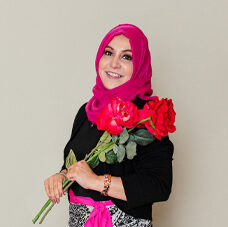
Uzma Atif is the founder and owner of Maroc Hamam Spa, where her passion for holistic wellness and authentic Moroccan spa traditions comes to life. With a deep belief that self-care is essential and not optional, Uzma has built a sanctuary where every guest is treated to a truly restorative experience. From steam therapies to rejuvenating facials and body treatments, she ensures every service reflects the highest standard of care, relaxation, and renewal.