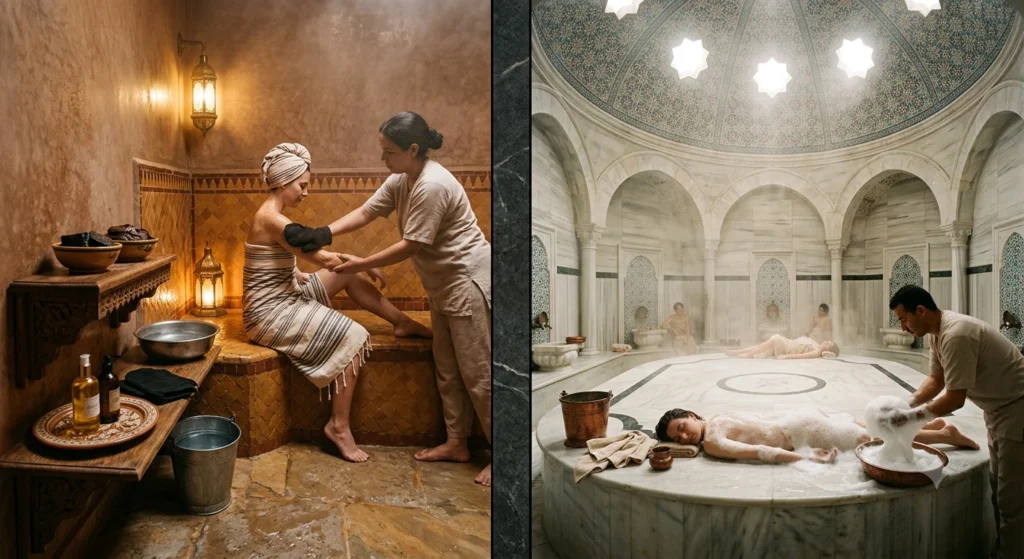
Both involve steam. Both involve scrubbing. Both leave you feeling cleaner and more relaxed than you have felt in months. So what actually makes a Moroccan hammam different from a Turkish hammam, and which one should you try first?
This guide answers both questions clearly. You will learn, step by step, what each ritual involves, which products are used, how the experience feels, and what your skin looks like afterwards. At the end, you will know exactly which one to book at Maroc Hamam Spa in Frisco, TX. If you also have general concerns about what a hammam involves, our guide to common Moroccan hammam myths covers the most frequent first-timer questions.
Where Does Each Tradition Come From?
Both trace their roots to the Roman bathhouse tradition. As the Roman Empire expanded across North Africa and into the Middle East, communal bathing became embedded in local cultures. Over centuries, each region shaped its own version of the ritual around religion, climate, and available ingredients.
The Moroccan hammam is rooted in Berber and Islamic wellness culture. Historically, hammams in Morocco were built near mosques to support ritual cleansing before prayer. They became weekly gathering spaces for women to wash, rest, and connect. The ritual evolved around locally sourced ingredients: black olive soap, exfoliation mitts woven from natural fibers, and mineral clay from the Atlas Mountains.
The Turkish hammam developed within the Ottoman Empire and reached its architectural height in the 15th and 16th centuries. Grand marble structures with domed ceilings and elaborate tiling became symbols of Ottoman refinement. The Turkish hammam placed equal weight on social ceremony and cleansing, built around the sensation of heat from warm marble and the luxury of foam massage.
The Moroccan Hammam: What Actually Happens
The Moroccan hammam is a skin-focused ritual. Every step has a specific purpose, and the result is visibly different skin in a single session.
- Steam phase: You begin in a heated room, sitting or lying on a warm surface. Steam opens the pores and warms the muscles, preparing the skin for what follows.
- Black soap (savon beldi) application: A traditional Moroccan soap made from fermented olive and argan oils is applied all over the body. It softens and loosens dead skin cells over 5 to 10 minutes.
- Kessa exfoliation: A therapist uses a kessa, a firm, woven mitt, to scrub the entire body in long, deliberate strokes. Dead skin visibly rolls away. The result is genuinely clean skin at a level a regular shower cannot reach.
- Ghassoul clay mask (optional): A natural mineral clay from Morocco’s Atlas Mountains is applied to absorb impurities and smooth the skin surface. Included in select packages at Maroc Hamam Spa.
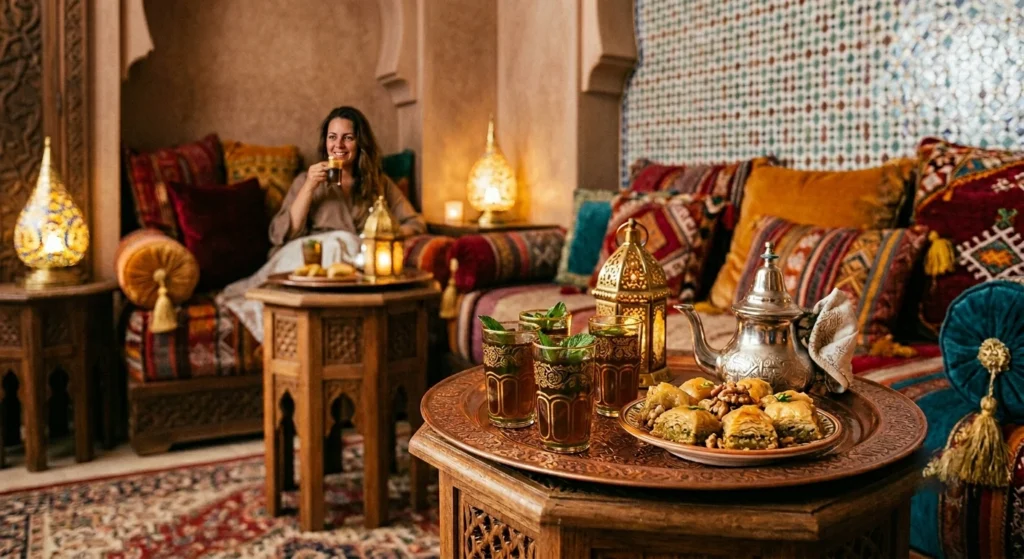
- Rinse and relaxation: Warm water rinses everything away. You move to the relaxation lounge where Moroccan mint tea and baklava are served.
The Moroccan hammam is a treatment-focused experience designed to purify and renew the skin. You leave with noticeably softer skin, clearer pores, and a body that feels genuinely different from when you walked in.
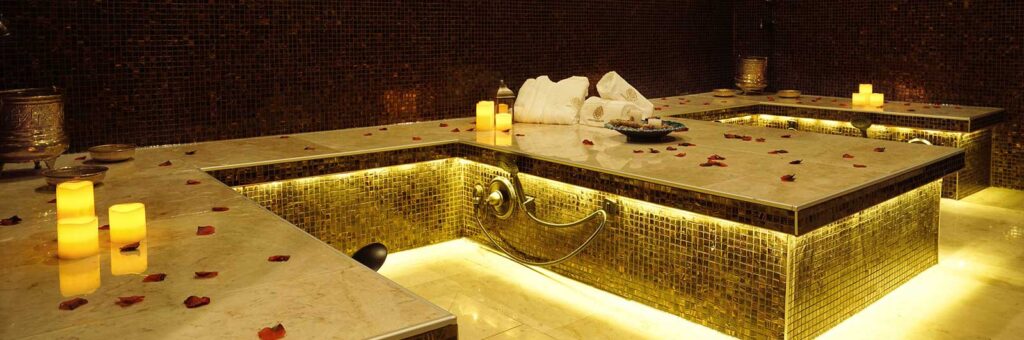
The Turkish Hammam: What Actually Happens
The Turkish hammam places greater emphasis on heat, relaxation, and the sensory experience of warm marble and soap foam. The process is less about deep physical exfoliation and more about heat therapy combined with a thorough cleanse.
- Heated marble slab (gobek tasi): You lie on a large heated marble platform. The stone conducts heat deeply into the muscles, relieving tension and inducing relaxation at a level that a regular massage takes longer to achieve.
- Steam and intense heat: Turkish hammams use high-humidity steam rooms. The heat is typically more intense than in a Moroccan hammam, a design feature intended to promote muscle relief and deep sweating.
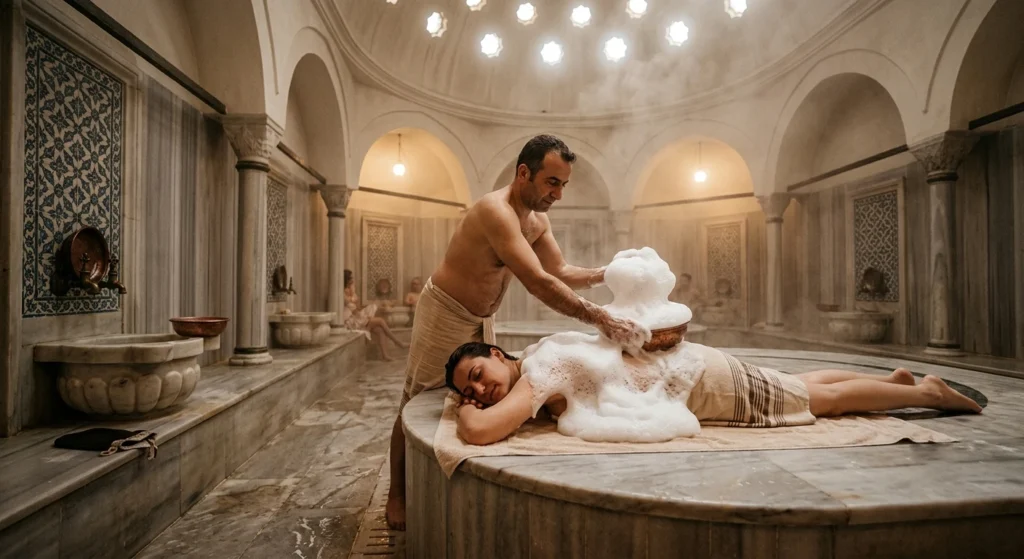
- Foam massage: An attendant creates large amounts of soap foam using olive oil soap and a fabric bag. The foam is spread over the entire body, and a firm but soothing massage follows. The sensation is unique to the Turkish ritual.
- Kese scrub: A kese glove removes dead skin after steam softens it. The scrub is effective but typically lighter than the Moroccan kessa exfoliation.
- Rinse and rest: The session ends with a rinse followed by cool-down time in a rest room with Turkish tea.
The Turkish hammam is a relaxation-first experience. It relieves muscle tension, improves circulation, and leaves skin clean and refreshed. The foam massage is a signature feature that has no equivalent in the Moroccan ritual.
Side-by-Side Comparison
Here is a direct comparison of the key differences between the two rituals.
| Feature | Moroccan Hammam | Turkish Hammam |
|---|---|---|
| Origin | North Africa, Berber and Islamic culture | Ottoman Empire, influenced by Roman baths |
| Primary focus | Deep skin cleansing and exfoliation | Relaxation, heat therapy, foam massage |
| Heat level | Warm steam, gentler and breathable | Intense steam, higher humidity |
| Main product | Savon beldi (black olive oil soap) | Olive oil soap foam (made with a torba bag) |
| Exfoliation | Kessa mitt – firm and deep, visible results | Kese mitt – lighter and less intensive |
| Clay treatment | Ghassoul clay mask (optional) | Not typically included |
| After treatment | Argan oil, Moroccan mint tea, baklava | Turkish tea, cooling room rest |
| Architecture | Earthy tiles, warm colors, intimate rooms | Grand marble, domed ceilings, ornate design |
| Session length | 45 to 60 minutes | 30 to 60 minutes |
| Skin result | Visibly smoother skin, deep pore cleansing | Refreshed and clean, muscle relaxation |
| Best for | Dry skin, exfoliation, deep cleansing | Stress relief, muscle tension, relaxation |
Products: What Goes on Your Skin
Moroccan Hammam Products
- Savon beldi: Black soap from fermented olive oil and argan oil. Softens dead skin before exfoliation. Natural, free from synthetic additives.
- Kessa mitt: Firm woven exfoliation glove. Physically removes dead skin cells after the black soap has loosened them. The most distinctive step of the Moroccan ritual.
- Ghassoul clay: Mineral clay from Morocco’s Atlas Mountains. Applied as a mask to draw out impurities and smooth the skin surface.
- Argan oil: Applied post-session to lock moisture into freshly exfoliated skin. Leaves skin soft without feeling greasy.
Turkish Hammam Products
- Olive oil soap foam: Traditional soap worked into a large cloud of foam using a torba bag. Used for the signature foam massage that defines the Turkish experience.
- Kese mitt: Coarse exfoliation glove used after steaming. Less intensive than the kessa, focused more on surface cleansing.
- No clay treatment: The ghassoul clay step is specific to the Moroccan ritual.
Which One Is Right for You?
Both are worth experiencing. But if you are choosing one for your first visit, here is how to decide.
Choose the Moroccan Hammam if you:
- Want the most visible skin result from a single session
- Have dry, flaky, or buildup-prone skin
- Are you preparing for a special event and want glowing skin
- Have never had a hammam before and want the full authentic ritual
- Deal with ingrown hairs and want exfoliation to address the root cause
- Are curious about savon beldi and ghassoul clay specifically
Choose the Turkish Hammam if you:
- Carry chronic muscle tension in the back, shoulders, or legs
- Want the sensation of warm marble and deep heat therapy
- Prefer a more relaxation-focused experience over an intensive scrub
- Want the signature foam massage experience
- Have more sensitive skin and prefer a lighter exfoliation
- Have already experienced the Moroccan hammam and want to try the Turkish version
Cannot Decide? You Do Not Have To.
At Maroc Hamam Spa in Frisco, TX, both treatments are available individually and as part of combined MHS Packages. If you are unsure, call us at (469) 803-5833, and we will help you choose based on your skin type and goals.
What to Expect at Maroc Hamam Spa in Frisco, TX?
Maroc Hamam Spa is the only women-only Moroccan hammam spa in Frisco, Texas, and one of the very few in the entire DFW area. We offer both the Moroccan hammam and the Turkish bath as individual treatments and as part of combined packages.
- Every treatment is performed by a certified female therapist in a private room
- All products are authentic Moroccan formulations, including savon beldi, ghassoul clay, and argan oil
- Women-only environment throughout, with no shared treatment rooms
- Relaxation lounge with Moroccan mint tea and baklava after every session
- 4.5 stars across 695 Google reviews from clients across Frisco, Plano, McKinney, Allen, and Dallas
- Open Tuesday through Friday 10 AM to 7 PM, Saturday and Sunday 10 AM to 6 PM
FAQs
What is the main difference between a Moroccan hammam and a Turkish hammam?
The Moroccan hammam focuses on deep skin cleansing and exfoliation using savon beldi (black soap) and a kessa mitt, with an optional ghassoul clay mask. The Turkish hammam emphasizes heat therapy and relaxation through a warm marble slab and a foam massage using olive oil soap. Both use steam and exfoliation but deliver different results. The Moroccan ritual targets the skin more intensively. The Turkish ritual prioritizes relaxation and muscle relief.
Which hammam is better for dry skin?
The Moroccan hammam is generally better for dry skin. The combination of savon beldi, kessa exfoliation, and argan oil, applied after the session, addresses dry skin at its root by removing the dead skin buildup that traps moisture. Many clients with chronic dry skin see a noticeable difference after a single Moroccan hammam session.
Which hammam is more relaxing?
The Turkish hammam is considered more focused on relaxation. The heated marble slab, high-humidity steam, and foam massage combine to create a deeply soothing experience that effectively relieves muscle tension. The Moroccan hammam is also relaxing, but its primary result is skin improvement. If relaxation is your main goal, start with the Turkish hammam.
Can I do both a Moroccan hammam and a Turkish bath in one visit?
Yes. At Maroc Hamam Spa in Frisco, TX, several MHS Packages combine both treatments in a single visit. Call us at (469) 803-5833 or book online to ask about packages that include both hammam treatments.
What is savon beldi, and why is it used in the Moroccan hammam?
Savon Beldi is a traditional Moroccan black soap made with fermented olive and argan oils. It is applied to the body during the hammam to soften and loosen dead skin cells, preparing them for physical removal by the kessa mitt. It is completely natural, has been used in Moroccan hammams for centuries, and leaves the skin noticeably nourished after the session.
Which hammam is better for a first-timer?
Both are excellent for first-timers. The Moroccan hammam is recommended if you want a visible skin result from your first visit. The Turkish hammam is recommended if you want a gentler introduction focused on relaxation. At Maroc Hamam Spa, we guide first-time visitors through every step before the appointment.
Does Maroc Hamam Spa offer both Moroccan and Turkish hammam treatments?
Yes. Maroc Hamam Spa in Frisco, TX, offers Moroccan hammam, Turkish bath, and combined packages. Certified female therapists perform all treatments in a women-only, private environment. Call (469) 803-5833 or visit marochamamspa.com to book.
Uzma Atif is the founder and owner of Maroc Hamam Spa, where her passion for holistic wellness and authentic Moroccan spa traditions comes to life. With a deep belief that self-care is essential and not optional, Uzma has built a sanctuary where every guest is treated to a truly restorative experience. From steam therapies to rejuvenating facials and body treatments, she ensures every service reflects the highest standard of care, relaxation, and renewal.