The Moroccan hammam ritual is one of the oldest continuous wellness practices in the world. For over a thousand years, women across North Africa have used this exact sequence of heat, soap, and exfoliation as part of their weekly routine. Not as a luxury. Not as an occasional treat. As a fundamental part of caring for the body.
The ritual has not survived this long by accident. Each step was developed for a specific physiological reason. The sequence is not arbitrary. Heat before soap. Soap before exfoliation. Exfoliation before clay. Clay before oil. Remove any step or change the order and the result is noticeably different.
This guide walks through every stage of the professional Moroccan hammam ritual exactly as it is performed at Maroc Hamam Spa in Frisco, TX. Not a home tutorial. Not a product review. The complete ritual, as experienced when performed by a certified female therapist using authentic Moroccan products in a private steam room.
The Cultural Roots of the Moroccan Hammam Ritual
Understanding where the ritual comes from makes the experience itself more meaningful.
The hammam tradition entered Morocco through Roman bathhouse culture, which spread across North Africa during the first century AD. As Islam spread through the region, the hammam was adopted and transformed. Hammams were built next to mosques specifically to support ritual cleansing before prayer. Purification was not just a health practice. It was a spiritual one.
Over generations, the ritual developed distinct Moroccan characteristics. The savon beldi was made from local olive pulp. The ghassoul clay came from the Atlas Mountains. The kessa mitt was woven from local plant fibers. Each ingredient came from the land, and each was chosen because it worked, tested across hundreds of years of weekly use by millions of women.
In Morocco today, the hammam is still a weekly ritual. Women visit on Thursday or Friday evenings to prepare for the weekend. The social dimension neighbors talking, mothers teaching daughters, friends sharing the steam room is as much a part of the tradition as the cleansing itself. What we offer at Maroc Hamam Spa in Frisco is the authentic ritual experience in a private, professional setting.
The Moroccan Hammam Ritual: Every Step Explained
At Maroc Hamam Spa, the full ritual follows the same sequence that has defined the Moroccan hammam for centuries. Here is what happens at each stage, why it happens in this order, and what you experience at every point.
The Steam Room
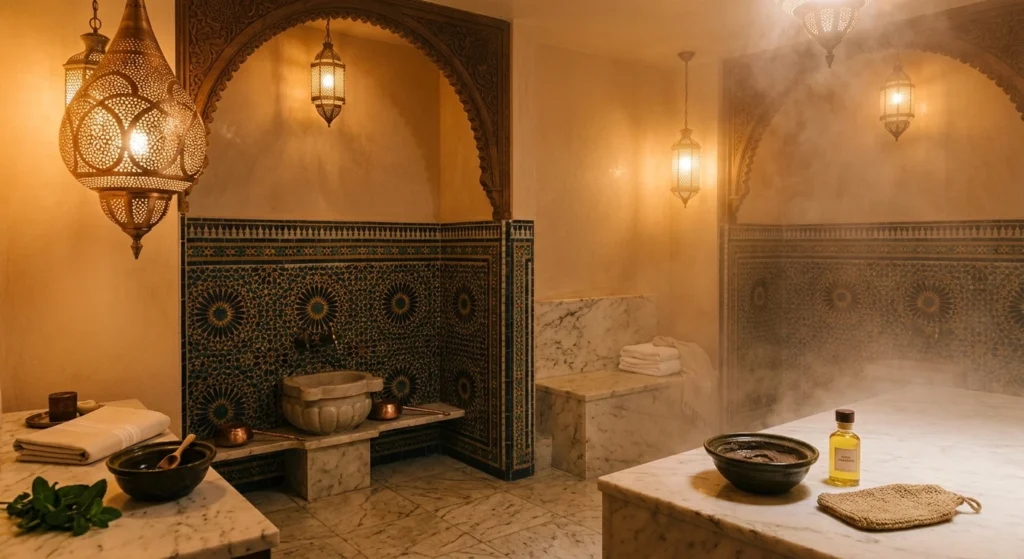
The ritual begins with heat. You enter the steam room and sit or lie on a warm marble surface while moist steam fills the space. The temperature is warm and enveloping, not aggressively hot. You are not in a sauna. You are in a steamed room designed to work with your body rather than against it.
What is happening physiologically: vasodilation opens the blood vessels, circulation increases, pores open, and the outermost layer of the skin begins to soften. This preparation phase is not optional or atmospheric. Without it, the savon beldi cannot penetrate the skin, and the kessa exfoliation that follows will be far less effective.
What you feel: warmth spreading through the muscles, a gradual release of tension in the back and shoulders, slowed breathing, the beginning of the shift from alert to calm. Most clients describe this stage as the moment they stop thinking about the rest of their day.
Savon Beldi Application
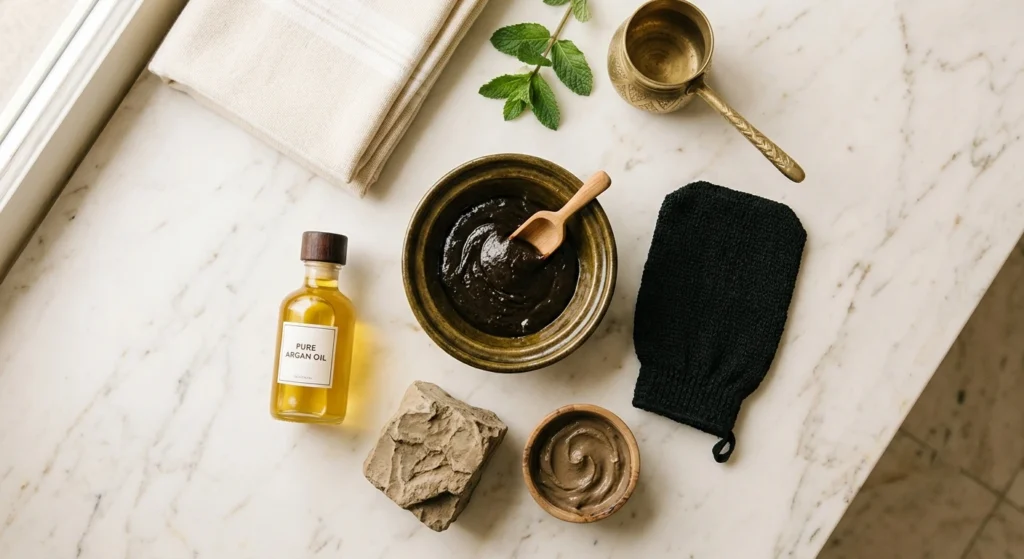
After the steam phase, your therapist applies savon beldi, Moroccan black soap, across the entire body. The soap is dark, paste-like, and unlike anything you have used at home. Made from fermented olive pulp and argan oil, it has a faint earthy scent and a texture that spreads easily across steam-warmed skin.
The soap is left on the skin for 5 to 10 minutes while you rest. During this time, the olive oil compounds in the soap penetrate the softened outer skin layer and break down the bonds that hold dead skin cells to the underlying surface. This preparatory step makes the exfoliation stage possible. Without it, the kessa works less effectively on unprepared skin, and the visible results are much weaker.
What you feel: the warmth of the soap against skin already softened by the steam. A faint sensation of the soap working. The smell is earthy and natural, not perfumed. Nothing sharp or chemical.
Kessa Exfoliation
This is the signature step of the Moroccan hammam ritual and the one that produces the most visible results. Your therapist uses a kessa, a firm woven exfoliation mitt, to scrub the entire body in long deliberate strokes from the feet upward. The dead skin, completely softened by the steam and soap preparation, rolls away visibly.
First-time clients are consistently surprised by how much comes off. This is not a sign that you are unusually dirty. This confirms that the steam-and-savon beldi preparation worked exactly as intended. What is being removed is weeks of dead skin cell buildup that no regular shower or loofah can reach because the skin was never properly prepared for removal.
Your therapist adjusts pressure based on your feedback throughout this step. The sensation is firm and rhythmic but should not be painful. If any area is sensitive, tell your therapist immediately, and they will adjust.
What you feel: firm pressure moving across the body in long strokes. A gradual warming in each area as circulation increases. And then, as your therapist moves to the next area and you notice how the skin feels, something genuinely surprising emerges: a smoothness that is immediately different from what was there before.
Ghassoul Clay Mask
Ghassoul clay, sourced from the Atlas Mountains of Morocco, is applied across the body after the kessa step. The clay is a natural mineral formation uniquely high in silica, magnesium, and calcium. Applied to freshly exfoliated skin, it draws out remaining impurities from the now-open pores via mineral absorption.
This step uses a different mechanism from soap and kessa. Where those steps remove what is on and in the skin surface, the clay draws out what is inside the pores. The result is deeper pore cleansing that directly addresses congested skin, oiliness, and uneven texture.
What you feel: the clay is cool against the skin, warm from the steam and exfoliation. A slight tightening sensation as it absorbs. The contrast of cool clay on warm skin is one of the more distinctive sensory moments of the full ritual.
Final Rinse
Warm water rinses away all remaining clay, soap residue, and lifted impurities. Your therapist helps guide you back to the changing area. The rinse is the transition point between the active treatment and the subsequent rest phase.
What you feel at this moment: the difference in your skin. It is not subtle. Every client notices it. The skin is smooth in a way that is physically different from how it felt when you walked in. Not just clean. Genuinely different in texture.
Argan Oil and Relaxation
A light application of argan oil is applied to the skin immediately after the rinse while the skin is still slightly damp and at its most receptive. Argan oil penetrates deeply into freshly exfoliated skin because there is no dead skin barrier to prevent it. What you feel is soft, hydrated skin rather than the tight dryness that sometimes follows strong exfoliation.
You then move to the relaxation lounge where Moroccan mint tea and baklava are served. This rest phase is not optional or just a pleasant extra. After 45 to 60 minutes of heat, steam, and physical treatment, the body needs time to settle. The cooling-down period as you drink tea is when the nervous system completes its shift into the parasympathetic rest-and-recovery state. This is where the mental benefit of the ritual finalizes.
What you feel: a combination of physical lightness from the completed treatment, genuine skin softness under your fingers, and a mental calm that most clients describe as distinct from ordinary relaxation. Several clients describe this stage as the clearest their mind has felt in weeks.
Why the Professional Ritual Delivers Results Home Use Cannot?
The professional hammam ritual and a home routine are not the same experience and do not produce the same results. Here is why.
Three Reasons the Professional Ritual Is Different
- Sustained steam at the correct temperature for 10 to 15 minutes. A hot shower produces steam briefly and at a lower temperature. The difference in how deeply the skin softens during the preparation phase is significant and affects every step that follows.
- A trained therapist applies the kessa with correct pressure, technique, and systematic coverage of the entire body. Self-exfoliation misses areas, applies inconsistent pressure, and cannot work from the angles a therapist uses. The visible skin removal is noticeably greater when done professionally.
- The complete product sequence is performed in the correct order with authentic formulations. Savon beldi made from genuine fermented olive pulp produces a different result from commercial versions that substitute synthetic ingredients. Ghassoul clay, sourced from Morocco, contains mineral profiles not replicated by most clay masks.
The Moroccan Hammam Ritual at Maroc Hamam Spa in Frisco, TX
Maroc Hamam Spa is located at 2552 Stonebrook Pkwy, Suite 730, Frisco, TX 75034. It is the only women-only Moroccan hammam spa in Frisco and one of the very few in the entire DFW area offering the complete authentic ritual.
- A certified female therapist performs every hammam ritual in a private treatment room
- Authentic Moroccan savon beldi, ghassoul clay, and argan oil used in every session
- No mixed spaces; women-only throughout the entire visit
- Relaxation lounge with Moroccan mint tea and baklava after every ritual
- Full hammam ritual sessions and combined packages available
- 4.5 stars across 695 Google reviews from clients across Frisco, Plano, McKinney, Allen, and Dallas
- Open Tuesday through Friday 10 AM to 7 PM, Saturday and Sunday 10 AM to 6 PM
FAQs
What is the Moroccan hammam ritual?
The Moroccan hammam ritual is a traditional full-body cleansing sequence rooted in centuries of North African wellness culture. It follows a specific order: steam heat to open the pores, savon beldi (black soap) to soften dead skin, kessa exfoliation to remove it, ghassoul clay to draw out impurities, and argan oil to seal moisture into freshly cleared skin. At Maroc Hamam Spa in Frisco, TX, the full ritual is performed by a certified female therapist in a private room using authentic Moroccan products.
How long does the Moroccan hammam ritual take?
The ritual itself takes 45 to 60 minutes. If you add a massage, facial, or other treatment to a package, your total visit time is 90 minutes to 2.5 hours. We recommend arriving 10 minutes early for the intake process and changing.
Why does the hammam ritual follow a specific sequence?
Each step prepares the skin for the next. Heat opens the pores and softens the skin, allowing the savon beldi to penetrate more effectively. The soap loosens and softens dead skin cells so the kessa exfoliation can remove them completely. The ghassoul clay works on the now-open, freshly exfoliated pores. The argan oil is applied when the skin is most receptive to absorption. Skip or rearrange any step and the result is noticeably weaker.
What is savon beldi and why is it used in the ritual?
Savon beldi is traditional Moroccan black soap made from fermented olive pulp and argan oil. It is applied after the steam phase and left on the skin for 5 to 10 minutes. During this time, its olive oil compounds penetrate and soften the bonds between dead skin cells and the fresh cells beneath them. This preparation is what makes the kessa exfoliation step so effective. Without savon beldi, the kessa cannot produce the same result.
What is a kessa mitt and why is it used?
A kessa is a firm woven exfoliation mitt traditionally made from viscose or plant fibers. It is used after the savon beldi application to scrub the entire body in long, firm strokes. The combination of steam-softened skin and soap-loosened dead cells means the kessa can remove layers of buildup that a regular shower or loofah never touches. The visible rolling of dead skin during this step is normal and confirms the preparation worked.
Is the Moroccan hammam ritual different from a home scrub?
Significantly different. A home scrub on unprepared skin removes surface-level buildup at best. The professional hammam ritual follows a specific sequence: sustained steam at the correct temperature, authentic savon beldi applied and left on the skin, then a therapist-applied kessa exfoliation with proper technique and pressure across the entire body. Each step amplifies the next in a way that home routines cannot replicate. The visible result after a professional hammam ritual is in a different category from anything achievable at home.
Who is the Moroccan hammam ritual suitable for?
The hammam ritual is suitable for most women. It is particularly beneficial for women with dry or congested skin, women who wax or shave regularly and want to reduce ingrown hairs, brides preparing for their wedding, and anyone who wants a genuine full-body reset. Women who are pregnant should avoid the steam room, particularly in the first trimester. Please inform us of any health conditions or sensitivities when booking.
Uzma Atif is the founder and owner of Maroc Hamam Spa, where her passion for holistic wellness and authentic Moroccan spa traditions comes to life. With a deep belief that self-care is essential and not optional, Uzma has built a sanctuary where every guest is treated to a truly restorative experience. From steam therapies to rejuvenating facials and body treatments, she ensures every service reflects the highest standard of care, relaxation, and renewal.